
Acne can be over for years and still leave its mark, a daily reminder of past breakouts. If you are weighing up microneedling for acne scars, you probably want straight answers to a few questions. Will it help my type of scar? How many visits? What does it cost? And what will my skin look like the next morning?
This guide answers them the way a doctor would in a consultation: what microneedling can do, where it is limited, and when another scar treatment may suit you better.
What microneedling does to your skin
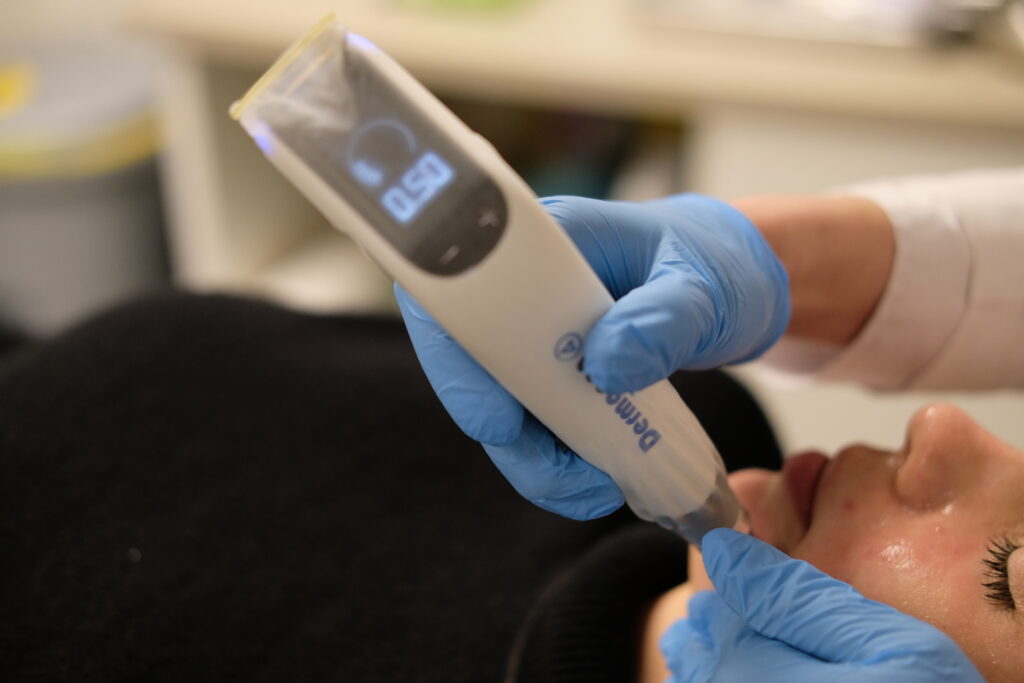
Microneedling, also called collagen induction therapy, is a minimally invasive microneedling treatment used in dermatology. A medical-grade microneedling device uses fine needles to puncture the skin’s surface in a controlled way. The tiny needles leave micro-injuries. Your skin treats these as small wounds and begins to repair them. That repair process is what produces more collagen, and with it more of the structure around it: collagen and elastin are the proteins that give skin its firmness and flexibility.
Scars form when the skin repairs itself unevenly after inflammation. Microneedling aims to prompt a more even repair. The aim is to improve the appearance of texture over a course of treatments as collagen production builds, and to reduce the appearance of marks, so you may end up with less noticeable scars over time, not with scars that vanish.
It is worth being clear about what that means. The NHS notes that treatment can improve how acne scars look, but cannot remove them completely (NHS, acne complications). A systematic review of randomised controlled trials of microneedling on its own, covering 12 studies and 414 participants, suggests it can improve scar appearance (Aesthetic Plastic Surgery, 2022). Improvement is the honest word. Individual results vary, and your response to treatment is hard to predict until you have started. Your doctor will talk you through what is realistic. Microneedling works on scars you already have: it does not stop new scars forming, so active spots are something to settle first.
Which scars respond to microneedling?
Atrophic scars are the dips and pits left in the skin, and they come in several types, from shallow to deep scars. The type you have shapes the plan.
- Rolling scars are shallow, wave-like dips with soft edges. These tend to suit microneedling well.
- Boxcar scars are wider, sharper-edged dips. Shallower ones can respond, while deeper ones may need more sessions or a different approach.
- Ice pick scars are narrow and deep. Microneedling may soften their look, but they are the hardest type to treat, and you may be advised to consider another option alongside it.
- Post-inflammatory marks are the flat red or brown marks left after a spot heals. They are not true scars, and they are often a good fit for treatment.
Many people have a mix. That is why a skin assessment comes before anything else at OSO. Our doctor will examine your skin in person, identify what you have and tell you honestly what to expect.
How many sessions will you need?
At OSO, a typical treatment plan is 2 to 3 sessions, about a month apart. Some people need only 2 sessions, while others have multiple treatments. After that, some people choose maintenance sessions every 3 to 6 months to keep their skin looking good.
This fits what is seen in research. Trials have used between 1 and 6 sessions, spaced 4 to 12 weeks apart. Collagen takes time to build, so results appear gradually rather than the week after a treatment session. Skin keeps remodelling over the following weeks, which is why sessions are spaced out, and you may need to wait to see full results.
The right number of microneedling sessions depends on how deep your scars are, how your skin responds and what you want to achieve. Many microneedling sessions are not needed by everyone, and your doctor will not add visits for the sake of it. It is agreed at your consultation, and you can adjust it as you go.
What happens at an OSO appointment
Your first visit is a consultation, with no pressure to book. Here is how a treatment appointment runs.
- Consultation and skin assessment. Our doctor looks at your skin, explains how we perform microneedling, asks about your history, including past acne treatments and any medicines you take, and agrees a plan with you.
- Cleanse. Your skin is thoroughly cleansed.
- Numbing. A topical numbing cream is applied and left to take effect so you are comfortable.
- Treatment. The doctor passes the device across the treatment area. The microneedling procedure takes about 30 minutes.
- Aftercare plan. Before you leave, you are told how to look after your skin over the coming days.
Treatment happens in a discreet, private room at our clinic at 1-5 Portpool Lane, between Farringdon, Clerkenwell and Holborn.
Does it hurt, and what are the days after like?
Most clients find it very tolerable. Sensation varies from person to person, and you can tell the doctor at any point if you need a moment.
Afterwards, expect your skin to look flushed, a little like mild sunburn. Redness usually settles within 1 to 2 days, and your skin may feel tight or dry as it recovers. We ask that you avoid make-up for at least 24 hours.
Plan your first session for a day when you do not have an important event the next morning. Everyone’s skin reacts differently, and your doctor will tell you what to expect for yours.
Looking after your skin after treatment
Your doctor will give you instructions specific to your skin. As a general guide, these are the post-treatment habits that matter most:
- Cleanse gently and moisturise as advised.
- Limit sun exposure and wear a sun protection product every day.
- Do not pick at flaking or peeling skin.
- Avoid make-up for 24 hours.
- Ask us before restarting strong skincare ingredients, such as retinoids or exfoliating acids, and keep to gentle skin products that will not irritate your skin while it heals.
- Stick to a simple skin care routine until your doctor says otherwise.
Please do not try to copy this at home. At-home microneedling and DIY microneedling with home rollers and pens are not the same as a medical-grade device used by a doctor, and using them on active or broken skin can cause irritation or infection. This is general information, not personal medical advice. Follow the instructions you are given at your appointment.
Who should wait, or choose something else
Microneedling is not right for everyone, and not right at every moment. Your doctor will check, before treatment, whether it suits you. They will ask about:
- Whether you have an active breakout or any skin infection in the area
- Whether you are pregnant
- Any medicines you take, including recent acne medication
- Your general health and skin history
For people with darker skin tones, skin that is prone to hyperpigmentation needs particular care and a tailored plan, so please tell the doctor. If microneedling is not suitable for you now, our doctor will say so and suggest what could work instead. For some scars, a referral to a dermatologist may be the right next step, or the doctor may talk through laser treatments as an alternative. If you choose not to go ahead, or the doctor advises against treatment, your consultation deposit is refunded.
Microneedling alone, or combined
Some people have microneedling on its own. Others add a second treatment to the same visit, depending on their skin and goals.
PRP
PRP uses a small amount of your own blood, prepared so the platelet-rich part can be applied to the skin. A meta-analysis comparing microneedling with PRP against microneedling alone has been published (Frontiers in Medicine, 2021). Your doctor can explain what the evidence does and does not show.
Exosomes and polynucleotides
Topical exosome therapy is offered with microneedling as an optional add-on.
Polynucleotide skin boosters are another option for skin quality that your doctor may discuss with you.
Chemical peels
Chemical peels work on the surface of the skin and are often suggested for post-inflammatory marks or uneven tone, alongside or instead of microneedling.
The evidence is stronger for some combinations than others. Adding a treatment is a choice to make with your doctor, not a default.
How much does it cost at OSO?
Our current prices are:
- Microneedling, single session: £200
- Microneedling, course of 3: £540
- Microneedling with exosomes, single session: £550
- Microneedling with exosomes, course of 3: £1,500
Prices are listed per treatment, so check the pricing page for the latest figures before you book.
Your consultation with our doctor is complimentary. We ask for a £50 refundable deposit to secure your booking. It is fully redeemable against any treatment you choose, and refunded if you decide not to proceed or the doctor advises that treatment is not suitable. Please see the pricing page for the cancellation terms.
Frequently asked questions
How many sessions do I need?
At OSO, a typical plan is 2 to 3 sessions about a month apart, with maintenance every 3 to 6 months if you choose. Your doctor agrees the plan with you after assessing your skin.
Can it remove scars completely?
No treatment removes them completely. Microneedling aims to improve skin texture and how the marks look. Your doctor will tell you what is realistic for your scar type.
Does it hurt?
Sensation varies. A numbing cream is applied beforehand to help with comfort.
How long is the recovery?
Redness usually settles within 1 to 2 days. Avoid make-up for at least 24 hours.
Can I have it if I still get spots?
It depends. An active flare in the area is something our doctor will check at your consultation, and they may advise waiting.
Book a consultation
If you would like to know what microneedling could do for your skin, the first step is a conversation. Book a complimentary consultation at our clinic in Farringdon, with a £50 refundable deposit to secure your slot. Our doctor will look at your skin, explain your options and give you honest advice, with no pressure to go ahead. You can read more about microneedling at OSO or get in touch to book.